How to put a VLT HVAC Drive FC 102 on BACnet MS/TP through its own RS-485 port, terminals 68 and 69: 8-30 Protocol = BACnet, the device instance every drive leaves the factory with (1), Max Masters 127, terminal 27 that coasts the motor whatever BACnet says — and the control timeout that counts writes, not reads. With a free BACManager workspace.
Sources: Danfoss VLT HVAC Drive Native BACnet Operating Instructions MG.14.C1.02, the FC 102 Programming Guides M0010001 (SW 5.41, 10/2019) and AU430028034214en-001901 (SW 7.61, 2024.10), BTL listing BTL-30670
// before you start
BACnet MS/TP is built into the FC 102
🔌
No option card for MS/TP
The drive's standard RS-485 “FC port” on the control card speaks BACnet MS/TP once 8-30 is set to BACnet. BACnet/IP needs the separate VLT BACnet/IP MCA 125 option, which has its own object list; or put a BACnet router in front of the trunk, or read MS/TP directly from a PC — see BACnet MS/TP over RS-485.
⚡
Wiring
Terminal 68 is P+, 69 is N−. Switch S801 BUS TER. terminates the port; it is OFF from the factory and must only be moved with the drive powered down. Daisy chain only — Danfoss allows no T-drops (use repeaters), 1200 m per segment, 100–130 Ω screened twisted pair, AWG 18, kept 200 mm from motor cables. Bias: not given.
📋
What the drive serves
BTL-30670 (firmware 1.11, BACnet revision 14): B-ASC with ReadProperty, WriteProperty, dynamic device and object binding, DeviceCommunicationControl, TimeSynchronization, ReinitializeDevice. No ReadPropertyMultiple and no COV are listed. Max APDU and segmentation: not given.
// setup
8-30 BACnet, then address, baud and instance
Parameter
Factory
Set to
8-30 Protocol
[0] FC
[5] BACnet. ([9] FC Option is for an external gateway on the port, not for native BACnet.) The 8-7* parameters appear once this is set
8-31 Address
1
A free MS/TP MAC, 1–127. The documents give the range three ways (1–127, 0–255, 1–255 “depends on protocol”)
8-32 Baud Rate
see note
[2] 9600, [3] 19200, [4] 38400 or [6] 76800 — the only rates valid for BACnet. Set it; do not rely on the default
8-70 BACnet Device Instance
1
A device instance unique in the building, 0–4194302. It does not follow the MAC
8-72 MS/TP Max Masters
127
The highest master MAC on the trunk. Danfoss: lowering it speeds up the token passing
8-73 MS/TP Max Info Frames
1
Frames per token, 1–65534; usually leave
8-74 “I-Am” Service
[0] at power-up
[1] Continuously sends I-Am about once a minute
8-75 Initialisation Password
see note
The password ReinitializeDevice needs
8-01 / 8-02
[0] Digital and ctrl. word / FC port
8-01 [0] or [2] Controlword only; 8-02 [1] FC Port
8-50 Coasting Select
[3] Logic OR
[1] Bus, or keep +24 V on terminal 27 — see the rules below
Danfoss' worked example sets 8-30, 8-31, 8-32, 8-50, 8-70 and 8-72, then says the drive must be switched off and on again before the changes apply. The documents do not agree on every factory value: for 8-32 the native-BACnet manual's setup table says 9600 while its parameter text marks 38400 and adds that the default belongs to the FC protocol; for 8-75 the setup table and the MCA 125 guide say “admin”, the parameter text shows 0, and the 2019 and 2024 programming guides only say “size related”. A BACnet value for 8-33 Parity / Stop Bits is not given. Check on your drive.
// control
RUN/STOP Command, a reference, and which one counts
The command objects write the drive's FC-profile control word, as Danfoss' object table lists. The reference is a percentage in AV:1 or AV:2 — only one of them is active, and BV:2 decides which.
Object
Object name
Control word
To run
BV:1
RUN/STOP Command
CTW 047C (+ bit 15 reverse)
1 — start; 0 — stop
BV:2
REF 1 / REF 2 Select
—
Picks AV:1 or AV:2 as the reference
AV:1 / AV:2
Input Reference 1 / Input Reference 2
reference
%, the active one
BV:3
Fault Reset Command
bit 7
0 → 1 resets a trip
BV:24
Coasting
bit 3
Leave alone unless you have tested which value coasts
MSV:1
Active Setup
bits 13, 14
Selects set-up 1–4
!
Our reading, check it
Danfoss does not say which BV:2 state selects AV:1, which BV:24 state coasts, or what 100 % of AV:1 is (we assume the reference range, 0–50 Hz in our simulator). The FC 102 Design Guide (MG11BC02) defines the control-word bits: bit 3 at 0 coasts, the reset acts on the leading edge. Try it on the drive with the motor safe before you rely on it.
%
AV:3 is a percentage too
Output Speed is 16-17 Speed [RPM] divided by 4-13 Motor Speed High Limit [RPM], times 100 — not of the nominal speed. For Hz read AV:25 Frequency, for amps AV:5 Motor Current.
✋
Running is BV:33
BV:4 RUN / STOP Monitor is mapped to status-word bit 1, which the Design Guide calls drive ready. Whether the motor turns is BV:33 Running (bit 11). BV:32 Bus control (bit 9) is 0 when the drive is in local control and BACnet commands are ignored.
// the rules that bite
Terminal 27, the timeout, instance 1
27
Terminal 27 coasts
Terminal 27 is “Coast inverse” from the factory and needs +24 V before the drive will start; 8-50 Coasting Select is Logic OR, so an open terminal 27 coasts the motor whatever BV:1 says. Danfoss' BACnet text asks for 8-50 = Bus [1] or Logic AND [2], with 8-01 at [0] or [2] — although its own setup table lists Logic OR. Terminal 37 Safe Stop overrides everything.
17
Writes, not reads
With 8-04 Control Timeout Function set (factory Off), the drive acts when the control word is not updated within 8-03. The 2019 guide lists the BACnet objects that retrigger it: AOs, BOs, AV0, AV1, AV2, AV4, BV1–BV5, multistate outputs. A BMS that only reads trips alarm 17 Control word timeout. The old native-BACnet manual says 8-03/8-04 are not enabled at all in its version: firmware-dependent.
#1
Every drive is instance 1
8-70 is 1 from the factory, and Max Masters is 127. Two new FC 102s on one network answer Who-Is with the same instance. Set 8-70 on each one before the BMS discovers them.
// points list
The FC 102 points a BMS uses
Object names as Danfoss lists them (defaults: Danfoss marks the names writable, so a drive may show renamed points). C = commandable (priority array), W = writable, R = read only. The drive parameter or control/status-word bit is in brackets.
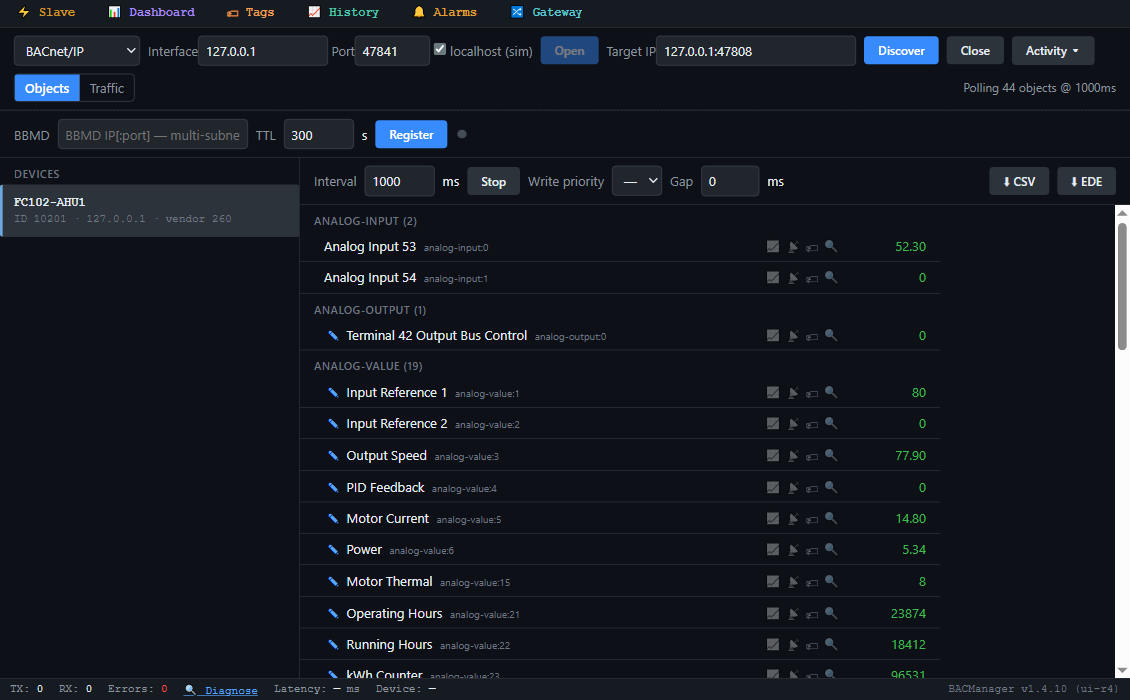
The drive's objects by name in BACManager (simulated drive built from Danfoss' object table)
Object
Object name
Access
What it is
BV:1 / BV:3
RUN/STOP Command / Fault Reset Command
C / W
Start (CTW 047C); reset (bit 7)
BV:2
REF 1 / REF 2 Select
C
Which reference is active
AV:1 / AV:2
Input Reference 1 / 2
C
Reference, %
BV:24 / BV:25 / BV:26 / BV:34
Coasting / CW/CCW / Jog / Ramp 1/ Ramp 2
C
Control-word bits 3 / 15 / 8 / 9
BV:33 / BV:31
Running / Speed = reference
R
Status-word bits 11 / 8
BV:21 / BV:22 / BV:23
Warning / Trip / Triplock
R
Status-word bits 7 / 3 / 6
BV:4 / BV:5
RUN / STOP Monitor / OK / FAULT Monitor
R
Status-word bit 1; bits 3, 6, 7 together
BV:6 / BV:32
HAND / AUTO Reference / Bus control
R
16-95 bit 1 (which state is Hand: read its Active_Text); status-word bit 9
AV:25 / AV:3
Frequency / Output Speed
R
Hz (16-13); % of 4-13
AV:5 / AV:6 / AV:26
Motor Current / Power / Torque
R
A (16-14), kW (16-10), % (16-22)
AV:24 / AV:27
Motor Voltage / DC Link Voltage
R
V (16-12 / 16-30)
AV:28 / AV:15 / AV:29
Heatsink Temp. / Motor Thermal / Inverter Thermal
R
°C (16-34; the manual writes “Deg”); % (16-18 / 16-35)
AV:21 / AV:22 / AV:23
Operating Hours / Running Hours / kWh Counter
R
h, h, kWh (15-00 / 15-01 / 15-02)
BV:28 / BV:29
Reset KWh Counter / Reset Running Hours Counter
W
15-06 / 15-07
AV:51 / AV:50
Fault Code / Alarm Log: Error Code
R
BACnet fault code 1–21 (table below); last alarm number (15-30)
AV:4 / AV:30 / AV:31
PID Feedback / Setpoint 1 / Bus Feedback 1
R / W / W
%, closed-loop PID (20-21, 8-94); also Setpoint 2/3, Bus Feedback 2/3 at AV:35–41
AV:52–57
PID Start Speed … PID Diff. Gain Limit
W
PID tuning (20-83…20-96)
AI:0 / AI:1, BI:0–6
Analog Input 53 / 54, Digital input Term 33…37
R
The drive's own I/O (16-62 / 16-64, 16-60)
AO:0, BO:0/1, BO:4/5
Terminal 42 Output Bus Control, Digital Output Term 27/29, Relay 1/2
C
Outputs driven from BACnet
MSV:0 / MSV:1
Smart Logic Controller State / Active Setup
R / C
16-38; set-up 1–4
AV:51
Fault
FC 102 alarms behind it
1
Communication Error
17 Control word timeout, 34 Fieldbus fault
2 / 3
Over Current / Over Temperature
13, 40–42, 59 / 11, 29, 65, 69, 74…
5 / 6
Over Voltage / Under Voltage
5, 7, 64 / 1, 6, 8
8 / 9
Ground Fault / Motor Overload
14 / 10, 50–58, 222
15 / 16 / 17
Configuration Error / Feedback Failure / Output Phase Loss
70, 76, 79… / 60, 90, 192 / 30, 31, 32
21
Internal Drive Failure
23, 27, 38, 39, 47, 48, 73, 85, 86
That is the mapping in MG.14.C1.02 (21 codes in all). The 2024 programming guide adds 8-76 VFD Fault Code Mapping New, Off from the factory: set to On, AV:51 follows the ASHRAE p-VFD fault codes instead — so check 8-76 before you build alarm texts. Priority_Array and Relinquish_Default exist on the BOs and on the commandable AO, AV, BV and MSV objects; which priority a BMS should use, and the relinquish defaults, are not in the documents. BACManager writes at priority 8 unless you choose otherwise.
// free download
The FC 102 workspace
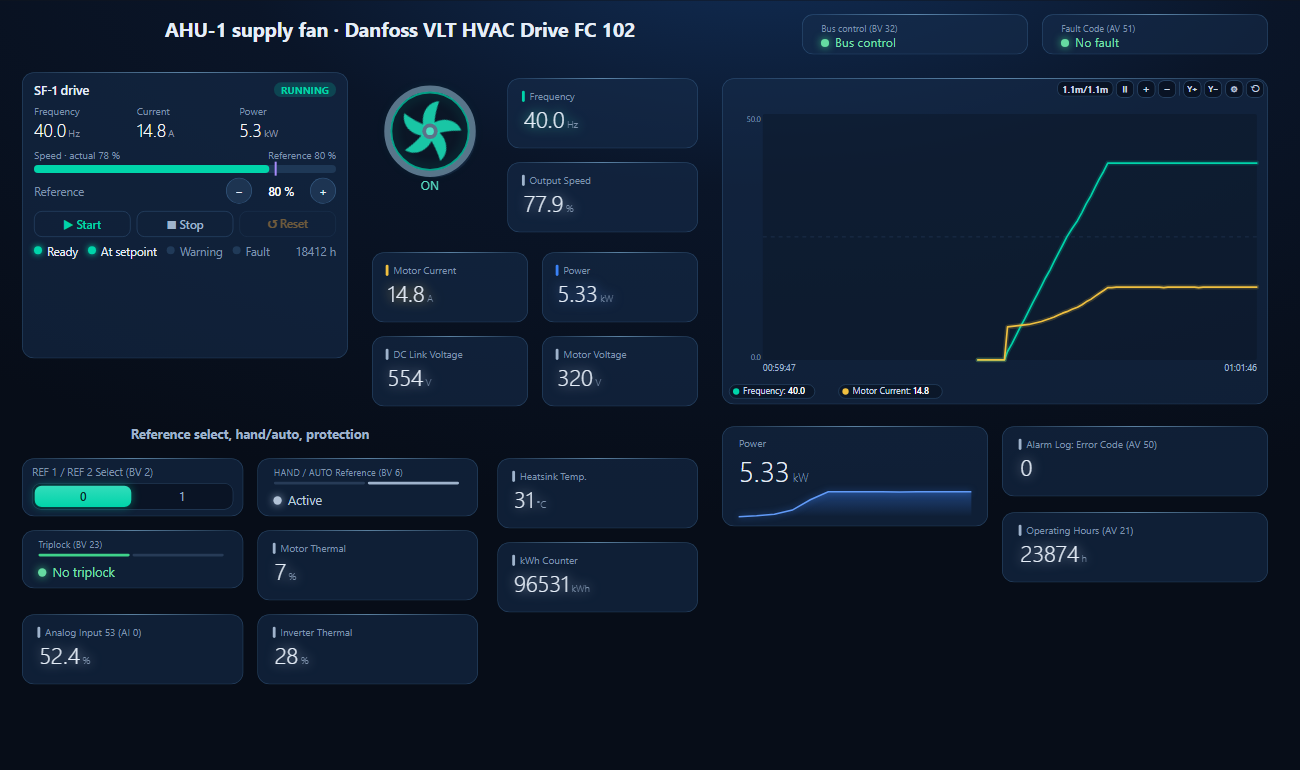
One dashboard page for an FC 102 on an AHU supply fan: the drive faceplate with run, trip and reference, the fan, frequency, output speed, current, power, both voltages, reference select, hand/auto, triplock, thermal values, energy and a trend.
Start and the reference from the faceplate; the drive ramps up while Input Reference 1 is re-written every 10 s for the control timeout (simulated drive)
1
Discover the drive
On the BACnet tab open MS/TP on the PC's RS-485 port at the 8-32 baud rate (or BACnet/IP behind a router) and press Discover. The drive appears with the instance from 8-70, and its objects by name.
2
Open the workspace
Workspace → Open. The file reads device 10201; if yours has another instance, BACManager asks which discovered device takes its place and moves every point over.
3
Timeout, then Start
The Input Reference 1 tag has Refresh (s) = 10: BACManager writes it again every 10 seconds, so set 8-03 well above that if you use 8-04. On the Dashboard press Run, then Start and the reference on the faceplate.
No +24 V on terminal 27 with 8-50 Logic OR; 8-01 Digital only; local control (BV:32 = 0); the other reference selected
8-50 = Bus, or wire terminal 27; 8-01 [0] or [2]; Auto on the panel; check BV:2
Drive trips with alarm 17, AV:51 = 1
8-04 is set and nothing was written within 8-03 — reads do not count
8-03 longer than the BMS's write interval, or re-write the reference (Refresh in BACManager)
Two drives answer as instance 1
8-70 factory value
Set the device instance on every drive
New settings ignored
BACnet settings apply after a power cycle
Switch the drive off and on
Group 8-7* not shown
8-30 is not BACnet yet
Set 8-30 = [5] BACnet first
The BMS gets an error to ReadPropertyMultiple
BTL-30670 lists ReadProperty only
Poll with ReadProperty
COV subscription refused
No COV in the listing
Poll those points
Fault codes do not match the table
8-76 VFD Fault Code Mapping New is On
Use the ASHRAE p-VFD list, or set 8-76 Off
Drive clock wrong after a power cut
The real-time clock has no battery
Let the BMS send TimeSynchronization
// questions
Danfoss FC 102 BACnet — FAQ
How do I enable BACnet on a Danfoss FC 102?+
Wire the trunk to terminals 68 (P+) and 69 (N−), set 8-30 Protocol = [5] BACnet, 8-31 the MS/TP address (1–127), 8-32 the baud rate (9600, 19200, 38400 or 76800), 8-70 a unique device instance and 8-72 the highest master address, then switch the drive off and on.
What is the default BACnet device instance of an FC 102?+
1, on every drive (8-70). Max Masters 8-72 is 127 and Max Info Frames 8-73 is 1. The factory baud rate is given differently in different Danfoss documents, so set 8-32 explicitly.
Which object starts the drive?+
BV:1 RUN/STOP Command. The reference is AV:1 Input Reference 1 or AV:2 Input Reference 2, whichever BV:2 REF 1 / REF 2 Select chooses. 8-50 Coasting Select has to be Bus, or terminal 27 must carry +24 V, or the motor stays coasted.
Why does the FC 102 trip with alarm 17 on BACnet?+
8-04 Control Timeout Function is set and the control word was not updated within 8-03. On BACnet the timer is retriggered by writes to the command objects (AV1, AV2, BV1–BV5, outputs), not by reads. Make 8-03 longer than the BMS's write interval, or set 8-04 Off.
Does the FC 102 support ReadPropertyMultiple or COV?+
BTL listing BTL-30670 (firmware 1.11) lists neither: ReadProperty, WriteProperty and device-management services only. Plan for polling with ReadProperty.
Does the FC 102 support BACnet/IP?+
Not on the built-in port, which is MS/TP. Danfoss offers the VLT BACnet/IP MCA 125 option, which shares 8-70 with MS/TP and has its own object list. Or reach MS/TP through a BACnet router; BACManager also reads MS/TP directly from a USB RS-485 adapter.
// sources
Where this comes from
Danfoss A/S: VLT HVAC Drive Native BACnet Operating Instructions MG.14.C1.02 (undated, older firmware); VLT HVAC Drive FC 102 Programming Guide M0010001, software 5.41, 10/2019, and AU430028034214en-001901, software 7.61, 2024.10; FC 102 Design Guide MG11BC02, 06/2014 (control and status word); VLT BACnet/IP MCA 125 Programming Guide AU361182716349en-000201, 2025.12; and BACnet International listing BTL-30670 (VLT HVAC Drive FC102, firmware 1.11, tested July 2020). The native-BACnet manual is old and contradicts itself on several factory values and ranges; where it does, this page says so. Get the documents from danfoss.com and check them against your drive's firmware. The “our reading” notes are ours, not Danfoss statements. Danfoss and VLT are trademarks of Danfoss A/S; BACManager is not affiliated with Danfoss. The pictures on this page are from BACManager connected to a simulated drive built from the published object table.
Download the free trial, discover the drive and open the FC 102 workspace — every point by name, the reference re-written for the control timeout. No credit card.